Payload optimization for bulk fuel
Stop leaving payload at the rack.
ProTankr calculates how much you can actually load, based on your equipment, product, temperature, compartments and legal weight.
Every load could have carried more. Now it will.
Across the country, drivers load bulk fuel conservatively on purpose. A safe, memorized number, well under the legal limit, loaded the same way every time. It's not carelessness. It's one too many tickets, permanently forcing the safe volume lower. Far less than legal.
Most conditions drift slowly enough that a small buffer absorbs them. The real damage comes from something bigger, a single shock, like an unexpected fuel import shifting a terminal's conditions for a few days. The event passes. The drivers have a new, lower memorized volume to load.
Every load teaches ProTankr something. When conditions shift and catch a driver off guard, the network adjusts. The truck behind them doesn't repeat it, and nobody has to guess low forever because of one bad day.
See what you could recover.
Check a real load against your legal limit. Enter what was on the ticket and see where it actually landed.
Tare weight, product API gravity, product temperature, actual gallons loaded from the BOL, and your legal weight limit.
This is an estimate, using standard published density tables, not the automatic tuning ProTankr applies for each specific product in the real app.
Know your real weight before you pull away.
Tare weight. Product density. Temperature. Compartment constraints. Legal weight. ProTankr turns all of it into one practical answer: how much can I legally and reasonably put on this trailer, right now.
- •Equipment awareTare weight, compartment count, and how much each compartment can legally hold, keyed to the exact truck and trailer you're pulling today.
- •Temperature awareLive API and temperature drive the density math, so the payload number reflects today's conditions, not a guess from last summer.
- •Payload focusedEvery variable resolves to a single number you can act on at the rack, not a report to interpret later.
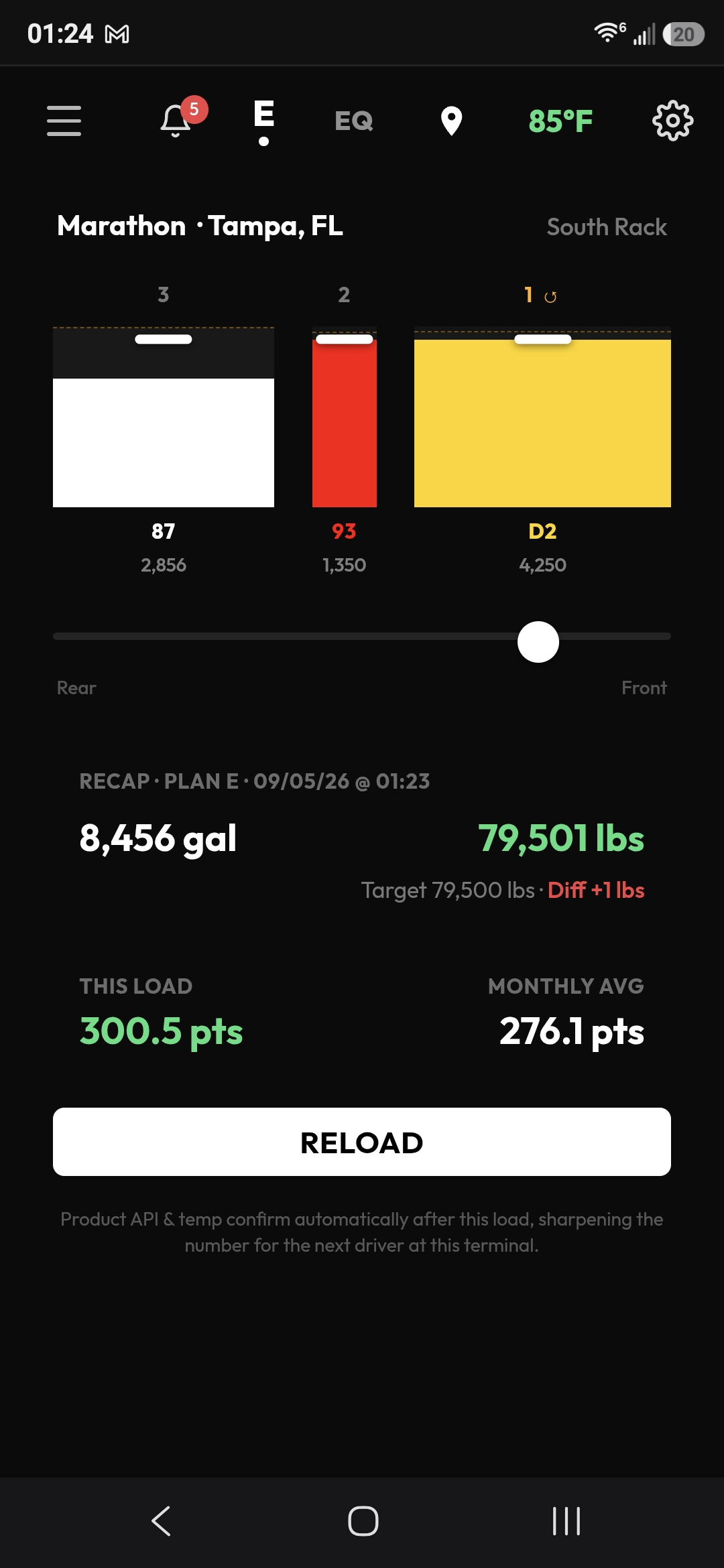
Calculate. Load. Capture.
Equipment, terminal, product and temperature go in. ProTankr returns your real available payload for this load, right now.
Load the plan at the rack. No guessing gallons twice, no falling back to the same conservative number out of habit.
The actual load gets captured automatically, so you always know what you moved and what got left behind.
One system, two views
Built for the driver. Built for the fleet.
Same equipment records, same terminal data, same shared knowledge — organized around whoever's actually looking at it.
Not another TMS.
Your TMS tells you where the truck is going. Your dispatch system tells you what to haul.
ProTankr tells you how much you can legally put on the trailer.
It works as an optimization layer alongside the systems you already have, not a replacement for any of them.
Shared knowledge
The driver in front of you already learned something.
A terminal that just ran out of a product. A verified API reading that corrects a stale prediction. Once one driver confirms it, the next one starts with better information instead of starting cold.
Out of Premium 93
Buckeye Bayway · Linden, NJ — flagged the moment a driver hit an empty rack. Every driver heading there next sees it before they roll up.
API reading verified
Marathon · Tampa, FL — one confirmed load corrects the terminal's predicted temperature for everyone loading there today, not just the driver who reported it.
The model improves with verified load data. Every confirmed result can make the next load more informed — shared knowledge becomes operational infrastructure.
“I didn't start ProTankr because I wanted to build trucking software. I started it because I was tired of leaving payload behind.”
“The event that caused it passes. The lower volume never does.”
Patent Pending
The Opportunity